
Summary
Client Service 101 is a scenario-based instructor-led course designed to prepare early career Associates to handle challenging situations with greater confidence, judgment, and consistency. By the end of the course, participants can identify where they are on the Ownership Spectrum and use the Act–Ask–Align framework to assess client situations, communicate with confidence, and make sound decisions about when to act independently, seek guidance, or align with their team.
Sessions are brought to life through realistic practice, discussion, and feedback from experienced client leaders. The experience extends beyond the classroom with a practical toolkit and Client Service Coach GPT that helps learners apply what they’ve learned in real moments at work.
Context
Audience
1
Edelman’s global Associate Practice: early career client-facing employees, usually with 0-3 years of experience in the PR/Communications industry. Each session is limited to 20 participants to maximize engagement, comfort, and reduce the student to instructor ratio for the best experience.
Roles
2
I worked with 8 different senior client-facing SMEs from a variety of client teams and countries to design and develop this training. I led all elements of building and designing this course and continue to update and adapt the training to align with the needs of diverse audiences at scale.
While I have also facilitated this training, it is usually delivered at the regional level with local facilitators who understand their market’s nuances.
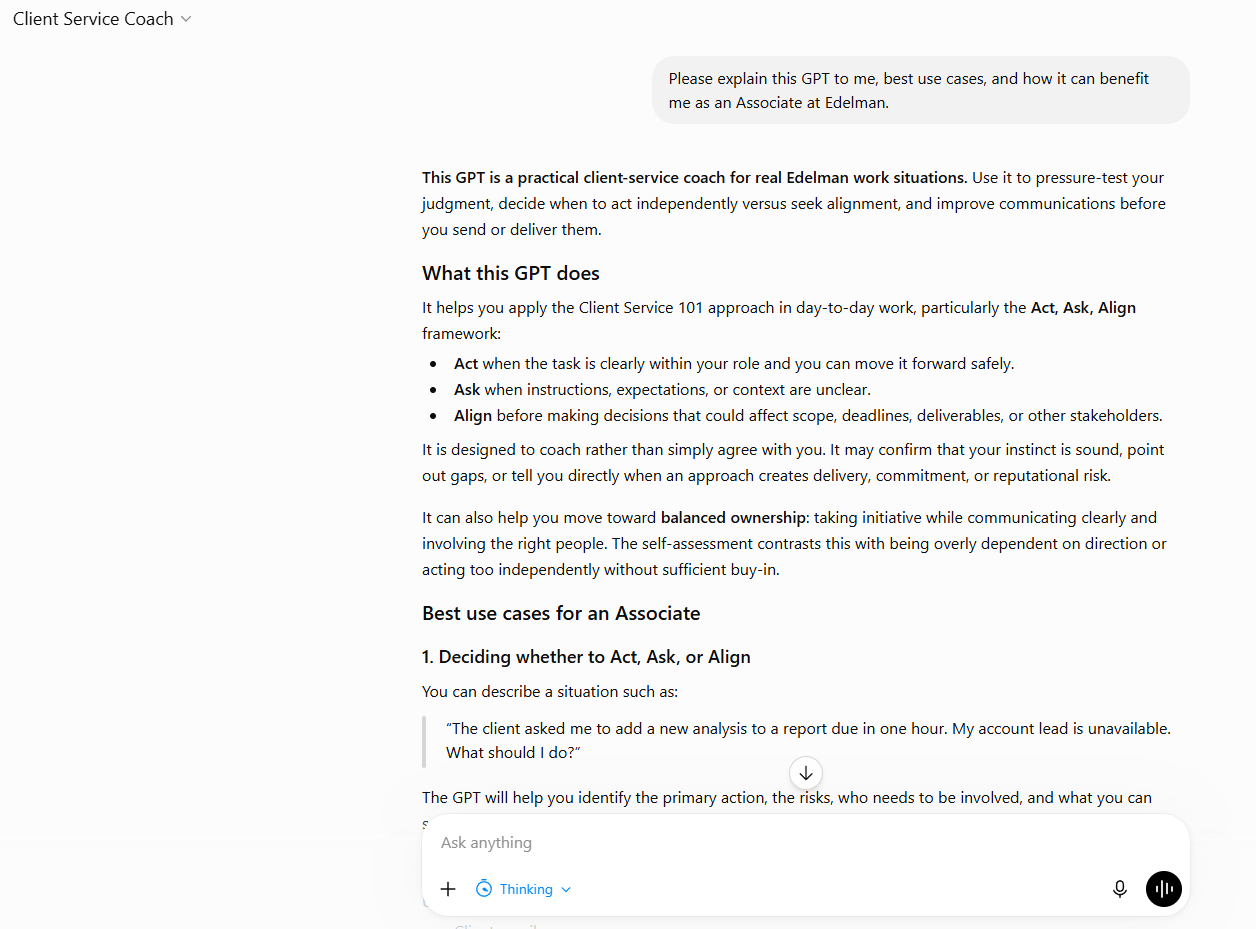
I also built the Client Service Coach AI Agent in ChatGPT to coach users according to the Ask-Act-Align framework, aiming to support learning in the flow of work.
Modality
3
Client Service 101 is a 2–3-hour instructor-led in-person or virtual experience developed in PowerPoint which includes a pre-work self-assessment and an interactive toolkit (workbook) to complement the course. Post-session, participants gain access to the Client Service Coach GPT and are guided to continue using the toolkit to support their learning after the session.
Client Service 101 is also a foundational course included in the Career Foundations: Associate Learning Pathways series I also designed, a globally available curriculum including a mixture of e-learning, instructor-led courses, and on-the-job resources to develop key operational rigor, inclusivity, trust & communication, and ownership behaviors expected of early career employees at Edelman.
Tools
4
Microsoft PowerPoint, Canva, Adobe, Microsoft Loop Workspace, Microsoft Teams and Polls (for virtual version), ChatGPT custom GPT features, Microsoft Forms, Edelman Brand Guidelines
Background
A UK-based Edelman team supporting a top-50 third-party logistics (3PL) client approached the Global Learning & Development team to help prepare its early-career Associates for an important pitch.
The team had identified a growing gap in how Associates demonstrated ownership. Some were overly cautious, hesitating to act, avoiding decisions for fear of making mistakes, and relying on peers for direction even on routine tasks. Others moved too quickly without aligning with the broader team, acting on incomplete information and creating errors that were either visible to the client or only discovered after they had become larger issues.
Through intake conversations and a broader needs assessment, I found that the challenge was not just a lack of ownership. It was a lack of shared expectations and confidence. Associates were being asked to “take ownership,” but the team had never clearly defined what balanced ownership looked like in practice. Working with subject-matter experts across several client teams, I translated those expectations into realistic behaviors and created an Ownership Spectrum Self-Assessment to help participants reflect on their strengths and growth areas without judgment.
The Act–Ask–Align framework gave Associates a practical way to decide what to do when a situation felt unclear, while scenario-based activities allowed them to practice communication across email, team discussions, meetings, and client-facing conversations. Learners practiced with one another and received feedback from senior client leaders in a low-stakes environment, helping them build confidence before applying the skills on the job. Participant feedback has shown that this combination of clarity, peer learning, and real-time coaching made challenging situations feel more approachable and easier to navigate.
Although the training was originally created for a specific client team, it quickly scaled into a global program. It is now required for all Associates in EMEA, with additional regions preparing to adopt it as the same ownership, confidence, and communication gaps have been identified across the broader Associate Practice.
Overview of the Experience
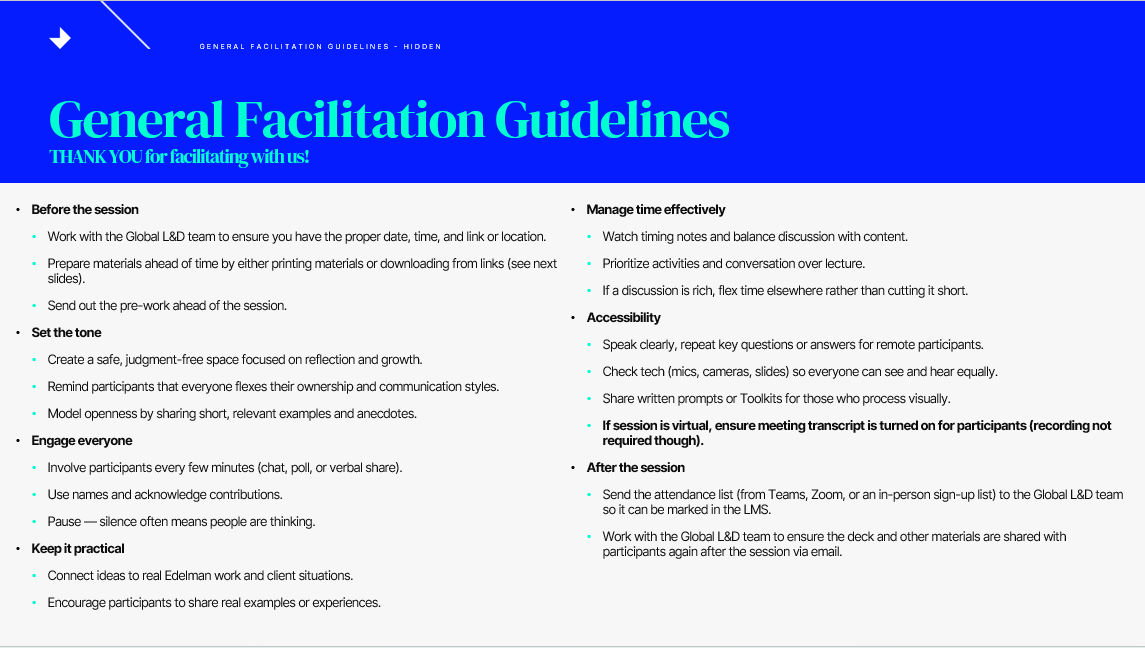
I designed the course for ease of facilitation, with hidden train-the-trainer slides that prepare both L&D facilitators and client-facing guest speakers to create a consistent, psychologically safe experience.
Before the session, participants complete the Confidence & Ownership Self-Assessment to begin reflecting on their habits and identify what they want to practice. Those who complete it in advance tend to arrive with greater curiosity and buy-in.
Train-the-Trainer
By the end of the session, participants will be able to:
Analyze challenging client scenarios and identify best solutions to respond with confidence.
Demonstrate how to set and manage expectations clearly across deliverables, timelines, and responsibilities.
Apply improved verbal and written communication techniques with both internal teams and clients.
Learning Objectives

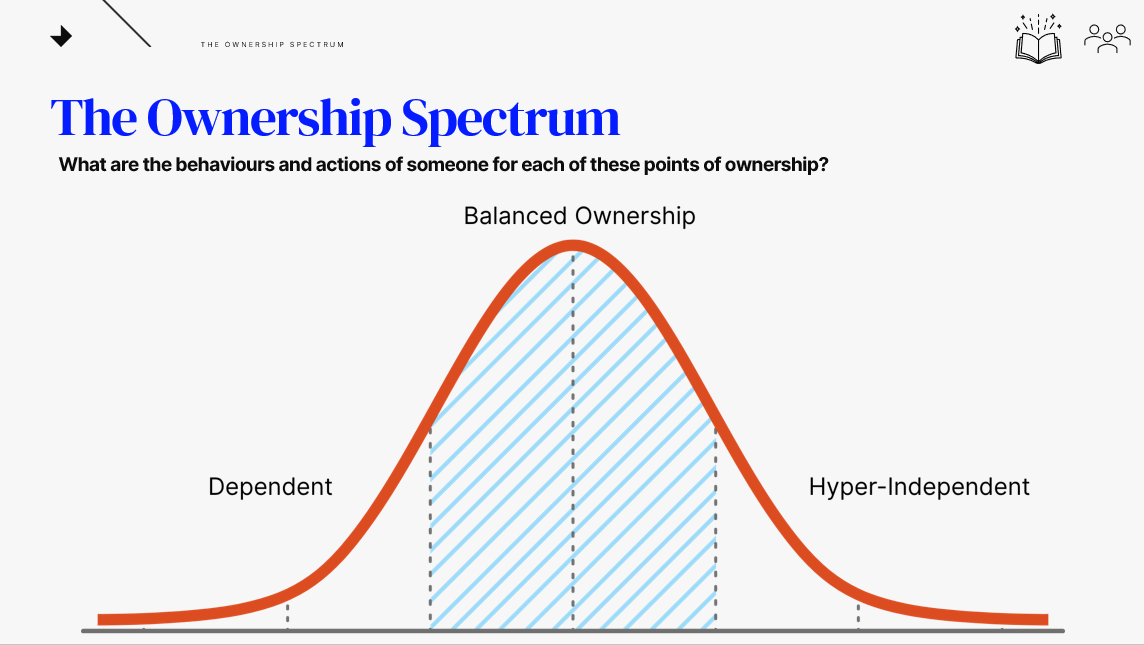
We open with a few “Client Curveballs” that prompt participants to reflect on their instincts, emotions, and next steps in challenging situations. We then use the Ownership Spectrum self-assessment, facilitator stories, and practical examples to define balanced ownership and show how everyday responses shape a person’s professional brand.
Ownership
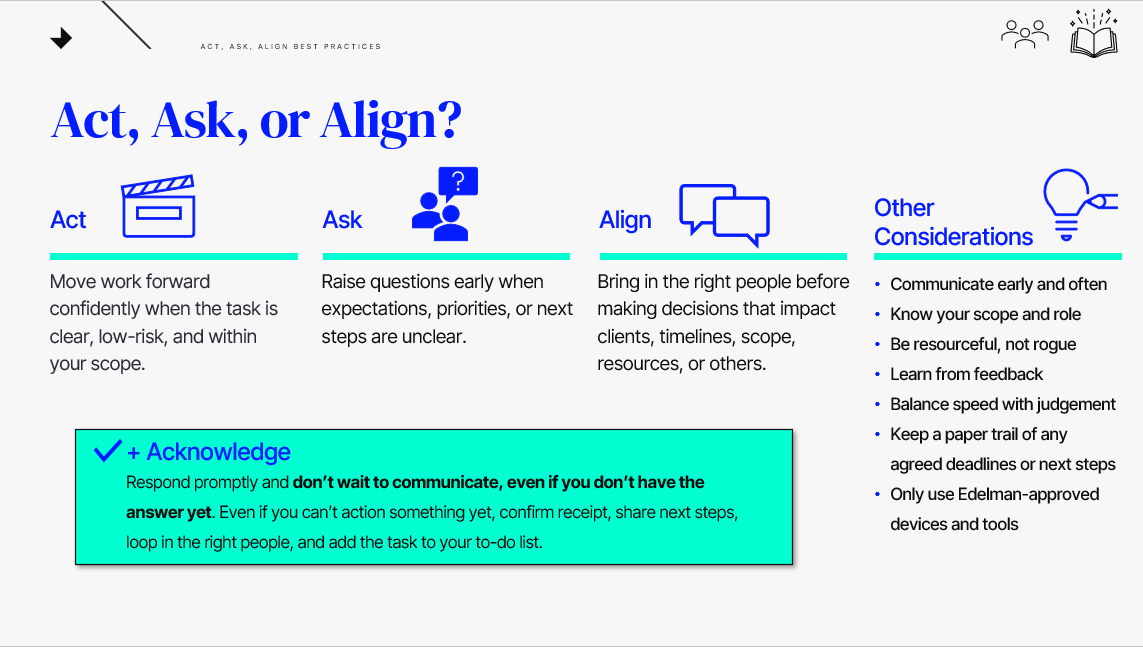
Act, Ask, or Align?
Next, participants learn the Act, Ask, or Align framework, with Acknowledge as the first step in any situation. They practice responding promptly, deciding when to move forward independently, when to ask for missing information, and when to align with the broader team before taking action.
Through realistic email and meeting scenarios, participants apply the framework, explain their reasoning, and receive feedback from peers and senior leaders. The goal is to build confidence, improve communication, and give Associates a practical decision-making tool they can use in the flow of work.
Navigating Stress & Ambiguity
Participants work through realistic, high-pressure client situations where the right next step is not always obvious. After practicing with peers, they take part in roleplays with senior leaders who offer real-time coaching, perspective, and encouragement. This is one of the first globally launched trainings at Edelman to bring senior leader practice and mentorship into the learning experience at scale, and feedback has been consistently positive. That direct access to experienced leaders has been one of the most valuable parts of the course.
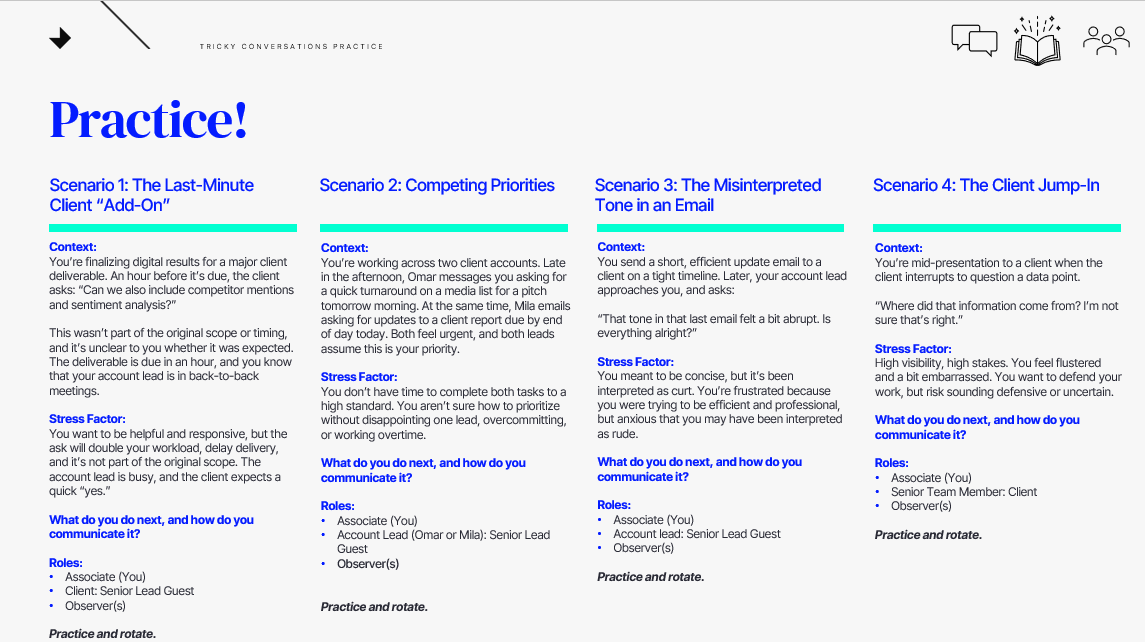
Communicating with Confidence
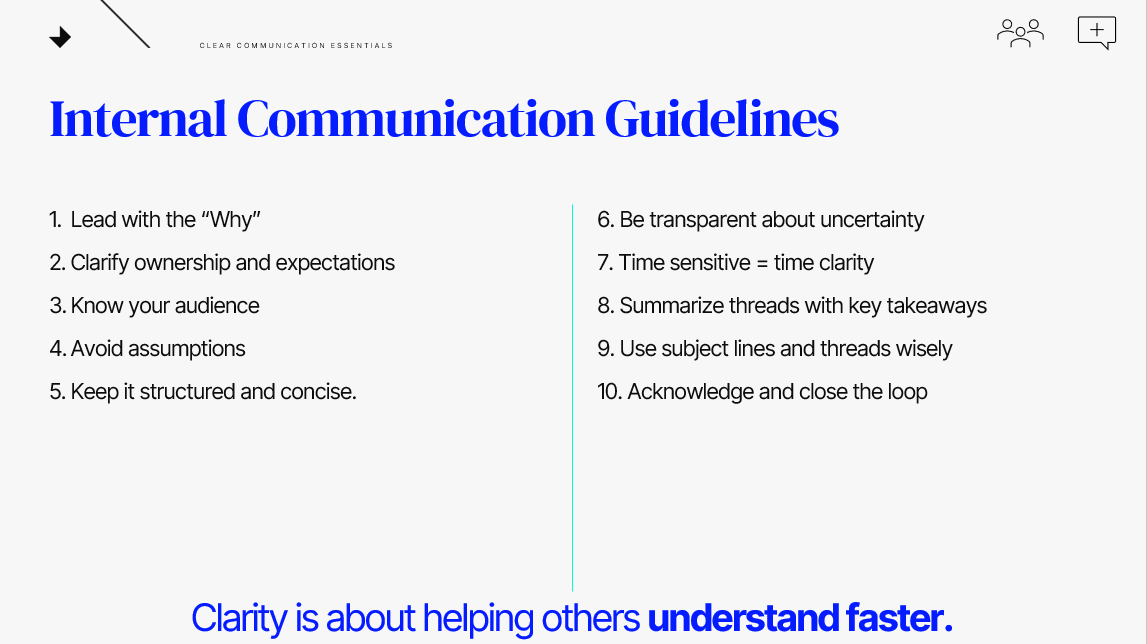
The course also focuses on how Associates communicate under pressure, especially through email and in meetings. I partnered with subject-matter experts to develop practical communication guidance based on real Associate emails, helping learners recognize common pitfalls, improve clarity and tone, and communicate with greater confidence in their teams and with clients.
Toolkit & Client Service Coach
The toolkit supports every activity by giving learners space to reflect, capture their thinking, and prepare before speaking, while also serving as a practical resource they can return to after the course. I extended that support into the flow of work by developing a custom Client Service Coach GPT, built around the Acknowledge, Act, Ask, or Align framework, so Associates can think through situations, refine messages, and gut-check their approach in the moment.
Communications & Launch Plan
The course was first piloted with the client team that identified the need, allowing us to test the experience and gather early feedback. After a successful pilot, the EMEA People Team made Client Service 101 a required course for all Associates across the region, and the program launched globally soon after. Communications included a promotional video and coordinated messaging across Viva Engage and SharePoint to build awareness, explain the value of the course, and drive registration.
The launch also required building a network of senior employees who could support the program as facilitators and guest leaders. I used the promotional materials and growing interest in the course to recruit a strong group of regular volunteers, who now help deliver sessions and promote the course within their own departments and locations.
Evaluation & Measurement
Evaluation combined a pre-work self-assessment repeated several weeks after the session, an immediate post-course survey, and follow-up outreach to Associates’ managers to identify changes in confidence, behavior, and on-the-job performance.
Results
90%
Agreed they could apply the learning to their work
“Thank you, Bernadette and team for creating this! I feel like we rarely talk about "how to" manage client challenges and are usually just thrust into them- leading to stress.
Breaking it down in this way made it feel a lot more approachable! I wish I had this guide 5 years ago!”
— Senior Lead Guest Speaker“I think the GPT will be really helpful. Very valuable to learn how other people approach different situations and how to break down different situations.”
— Associate Participant96%
Agreed the course objectives were clear and successfully met
“This was a great class- normalizing and discussing client challenges- prepares people for the chaos that is managing client comms. Knowing how to respond makes things less stressful in the moment. I feel like this should be mandatory training for those new to Edelman!”
— Senior Lead Guest Speaker“Main takeaway was to take a beat when in a difficult client situation. You don’t always have to answer right away. A good answer is better than a quick answer.”
— Associate Participant83%
Agreed the activities and exercises supported their learning
“It will change the way I approach client comms, make me think differently about my responses and when to act/align with team.”
— Associate Participant“As an intern, this course has been great at preparing me for future scenarios.”
— Intern Participant“Loved it, especially the senior colleagues group sessions!”
— Associate ParticipantWhat I learned from this project
As program manager for Edelman’s Global Associate Practice learning initiatives, I have seen Client Service 101 become a foundational part of our broader development strategy. The project reinforced something I have noticed across the learning and development field: ILT courses are still valuable, but they are most effective when they sit within a larger ecosystem that builds connection, supports continuous learning in the flow of work, uses AI responsibly, and connects learning to real business needs.
Client Service 101 was designed to be more than a presentation or a one-time workshop. The course is supported by practical resources, an AI coaching tool, complementary learning pathways, and follow-up surveys that encourage participants and managers to apply the learning over time.
I love designing training experiences, and this project confirmed for me that the greatest impact often comes when the course is only one part of the solution.